How the Hunter River Salinity Trading Scheme works
Salty water is only discharged when there is a lot of low salt, fresh water in the river. Every 2 years, a credit auction is conducted, where people can trade their salt discharge credits. People can only discharge the amount that their credits allow.
The Scheme involves a finite system of 1,000 salt credits that participants can buy and trade, allowing them to discharge their saline water into the Hunter River at times identified by the Service Coordinator, WaterNSW. WaterNSW operates and maintains a series of water flow and quality monitoring gauges along the river, providing real-time data which is then used to identify discharge opportunities.
Discharge opportunities are identified to the participants by publication of river registers. These are a notification published by WaterNSW when the flow in a particular sector of the river is high enough to allow discharge of saline water without going over the target EC for that sector. Each published river register includes a Total Allowable Discharge (TAD – referring to tonnes of salt) number which, together with their number of discharge credits, guides participants as to what they can discharge.
For the purposes of the Scheme, the river is divided into 3 sectors (Figure 1), with sector specific salinity targets. Flow conditions dictate when a river register is issued and hence discharge is permitted. These salinity targets and flow conditions are set out in the Protection of the Environment Operations (Hunter River Salinity Trading Scheme) Regulation 2002. In summary, when the river is in:
- Low flow, no discharges are permitted
- High flow, participants can discharge quantities based on the number of credits they hold
- Flood flow, participants can discharge freely irrespective of the salt credits they hold, if the salinity targets are not exceeded; this is monitored by WaterNSW.

Figure 1: Map of Hunter River sectors
The water in the river is nominally divided into numbered blocks. A block is a section of water that flows past Singleton in a day. So, block '2023-198' is the block of water that will flow past Singleton on the 198th day of 2023 (17 July). This block of water will flow past other points on the river on different days.
For each block, the scheme operators continually monitor the flow level and the ambient salinity and then calculate how much salt (if any) can be added to the block ('Total Allowable Discharge') so that salinity stays under the target.
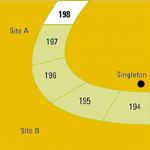
The river is divided into numbered blocks. For example, block '2023-198' will pass Singleton on the 198th day of 2010 (17 July). In this example, suppose block 198 could hold 112 tonnes of salt.
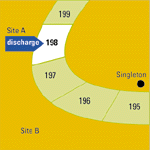
On 15 July, block 198 passes Site A. With 20 credits, Site A could discharge 2.24 tonnes (112 x 20 x 0.1%).
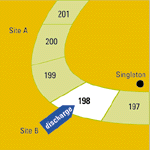
On 16 July, block 198 passes Site B. With 45 credits, Site B could discharge 5.04 tonnes (112 x 45 x 0.1%). If Site A did not discharge, it could trade 20 credits to Site B which could then discharge 65 credits of salt or 7.28 tonnes (112 x 65 x 0.1%).
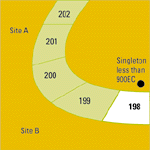
On 17 July, block 198 passes Singleton with salt concentration less than 900 µS/cm.
Contact us
- Email: [email protected]
- Phone: 131 555
More information
Credits
Scheme management