Wood smoke pollution
Smoke from wood heaters is a major cause of air pollution. Not only is a smoking fire wasting your money, but the air pollution it causes can also affect our health.
Wood smoke contains a number of noxious gases (including carbon monoxide, oxides of nitrogen, and a range of organic compounds, some of which are toxic or carcinogenic) and fine particles, which go deep into the lungs.
If you can see or smell smoke from your wood heater then you are causing a problem for yourself, your family and your neighbours.
That's why we need to change the way we use our heaters.
The EPA has developed two short (30sec) animations as part of a council resource kit to raise awareness about the harmful impacts of wood smoke pollution and provide practical tips for wood heater owners to better operate their wood heaters.
Contribution of wood smoke to air particle pollution
Wood smoke is a significant source of particle pollution, which can often be seen as a brown atmospheric haze on still, cool, winter mornings.
Table 1 shows the annual emissions contribution of domestic solid fuel combustion to total (i.e. human and natural derived sources) annual emissions of air pollutants in the Greater Metropolitan Region (GMR) and Sydney Region. Refer to Air Emissions Inventory for the Greater Metropolitan Region in NSW for a detailed description of sources, pollutants and regions.
It indicates that domestic solid fuel combustion contributes a significant proportion of many of the air pollutants listed.
|
Table 1
Annual emissions contribution (%) of residential wood heaters* |
| Air pollutant |
Greater metropolitan region |
Sydney region |
|
1,3-Butadiene
|
20
|
21
|
|
Acetaldehyde
|
14
|
32
|
|
Ammonia (NH3)
|
4
|
5
|
|
Benzene
|
15
|
17
|
|
Carbon monoxide (CO)
|
6
|
16
|
|
Formaldehyde
|
33
|
38
|
|
Isomers of xylene
|
1
|
1
|
|
Lead & compounds
|
1
|
5
|
|
Oxides of nitrogen (NOx)
|
<0.5
|
1
|
|
Particulate matter ≤ 10 µm (PM10)
|
6
|
28
|
|
Particulate matter ≤ 2.5 µm (PM2.5)
|
19
|
47
|
|
Polychlorinated dioxins & furans (PCDD & PCDF)
|
13
|
39
|
|
Polycyclic aromatic hydrocarbons (PAH)
|
32
|
35
|
|
Sulfur dioxide (SO2)
|
<0.5
|
1
|
|
Toluene
|
1
|
1
|
|
Total suspended particulate (TSP)
|
2
|
14
|
|
Volatile organic compounds (VOC)
|
3
|
5
|
|
*Source: Air Emissions Inventory for the Greater Metropolitan Region in NSW
|
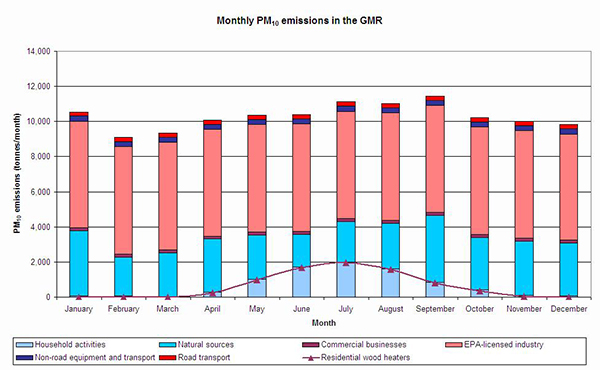
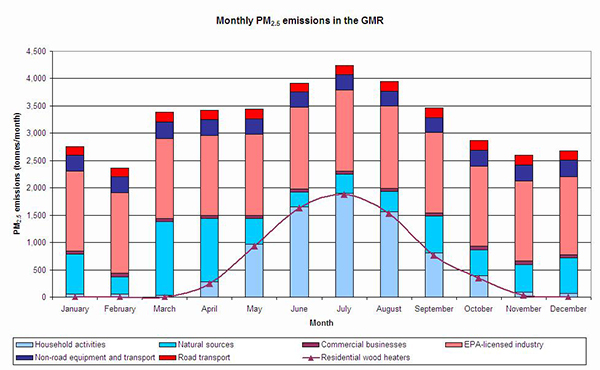
In the GMR, domestic solid fuel combustion contributes 6% and 19% of annual PM10 and PM2.5 particle pollution, respectively. The contribution of wood smoke is highest in July, making up 18% and 44% of monthly PM10 and PM2.5 particle pollution, respectively.
Figures 1 and 2 below show the average monthly emissions by sector and the contribution of domestic solid fuel combustion to total emissions of PM10 and PM2.5 particle pollution, respectively in the GMR.
Figure 1: Monthly PM10 emissions in the GMR*
Figure 2: Monthly PM2.5 emissions in the GMR*
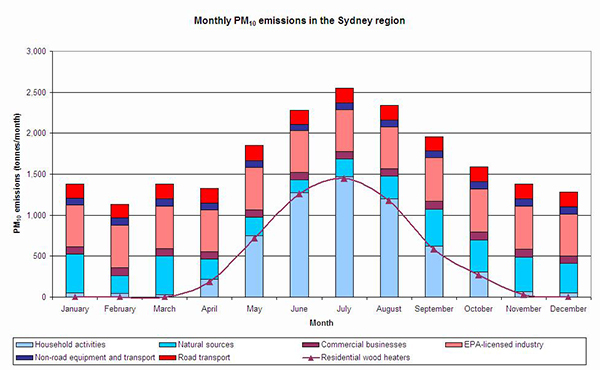
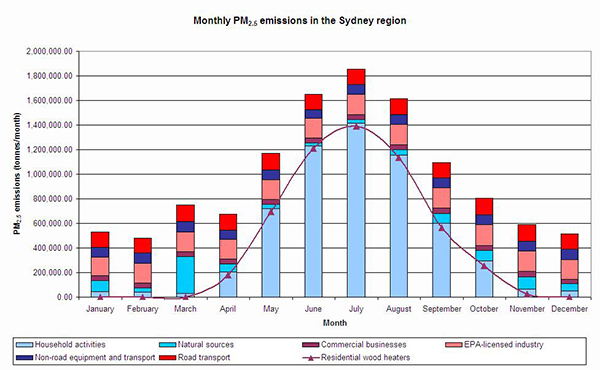
In the Sydney region, domestic solid fuel combustion contributes 28% and 47% of annual PM10 and PM2.5 particle pollution, respectively. The contribution of wood smoke is highest in July, making up 57% and 75% of monthly PM10 and PM2.5 particle pollution, respectively.
Figures 3 and 4 below show the average monthly emissions by sector and the contribution of domestic solid fuel combustion to total emissions of PM10 and PM2.5 particle pollution, respectively in the Sydney region.
Figure 3: Monthly PM10 emissions in the Sydney region*
Figure 4: Monthly PM2.5 emissions in the Sydney region*
In rural and regional areas in NSW where the climate is colder and wood heater ownership and usage is higher, the contribution of wood smoke to particle pollution would be higher than the GMR and Sydney region.
Influence of topography and the weather
Weather patterns during the winter months, together with the increase in wood smoke, influence air quality.
Wind, temperature and sunlight all have an impact on the movement and dispersion of particle pollution. Temperature inversions, where pollution is trapped in a cold layer of air at ground level, can also have an impact.
The topography of the Sydney Basin (and to a lesser degree that of the Illawarra and the lower Hunter) can also affect the dispersion of pollutants.
Community concern
EPA community research has consistently found air quality is the second most important environmental issue to NSW residents, following water issues.
Wood smoke pollution from neighbouring chimneys is the source of many complaints to local councils throughout NSW.
Regulation
Local councils are the regulatory authority responsible for dealing with woodsmoke emissions from residential properties.
Councils can issue smoke abatement notices under the Protection of the Environment Operations Act. A smoke abatement notice requires that a householder ensure that excessive smoke is not emitted from the chimney. The notice gives 21 days for any necessary improvements, maintenance or repairs to be carried out.