

The EPA has powers to direct responsible parties to manage significantly contaminated land under the Contaminated Land Management Act 1997 (CLM Act).
Significantly contaminated land
If we have reason to believe that land is contaminated and that the contamination is significant enough to warrant regulation, it will be declared as 'significantly contaminated land'.
Section 12 of the CLM Act lists matters to be considered to determine whether or not the land is significantly contaminated, including whether
-
the substances have already caused harm
- the substances are toxic, persistent or bioaccumulative or are present in large quantities or high concentrations or occur in combinations
- exposure pathways are available to the substances
- the uses to which the land, and land adjoining it, are currently being put are likely to increase the risk of harm
- the approved uses of the land and land adjoining it are such as to increase the risk of harm from the substances
- the substances have migrated or are likely to migrate from the land
Site-specific factors may also be considered.
The former declarations of land as 'investigation areas' and 'remediation sites' are taken to be declarations of significantly contaminated land from 1 July 2009.
Steps to regulate contaminated land
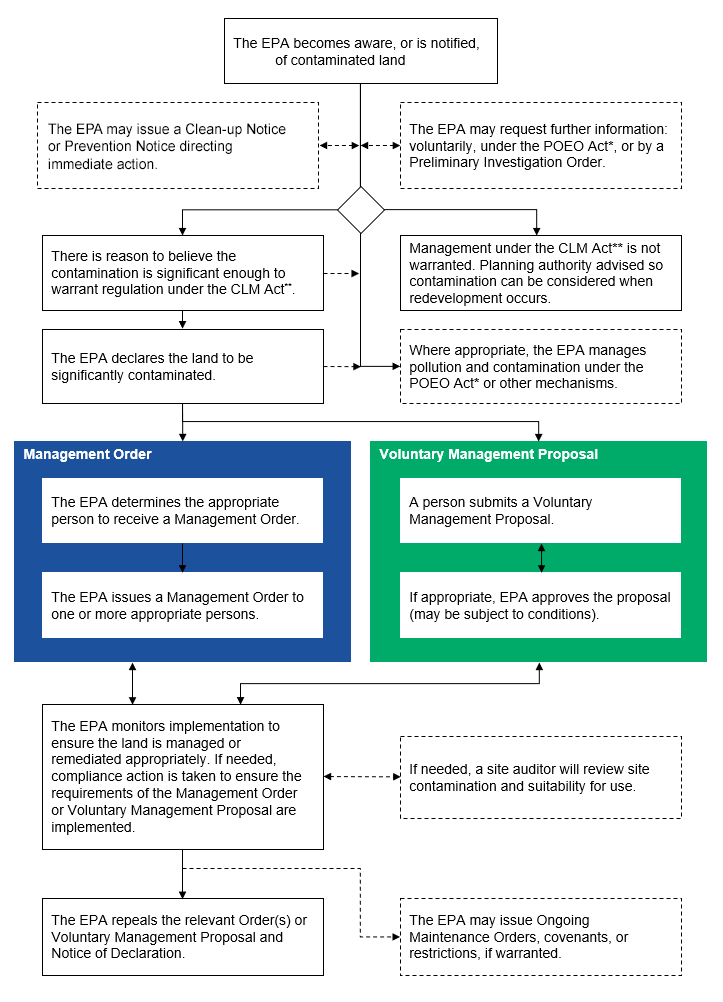
* Protection of the Environment Operations Act 1997
** Contaminated Land Management Act 1997
Assessing notified sites
We assess and respond to notifications of contaminated land. When there is not enough information on the nature or extent of the contamination for a proper assessment, we will request additional information.
We check that the notification is not a pollution incident. Pollution incidents, waste stockpiling, or dumping are managed under the Protection of the Environment Operations Act 1997 (POEO Act) and will be directed through the incident management process.
In most cases, the contamination does not pose a significant risk to human health or the environment. These sites may still need to be remediated, but can be done with any building or redevelopment of the land through the planning and development process. In these cases, we tell the planning authority so that the information can be considered at the right time.
Where we reasonably suspects that land is contaminated, and urgent action is required prior to determining whether the land is significantly contaminated, we can issue clean-up or prevention notices in relation to land that has been notified under s.60 of the CLM Act.
Where land has been assessed as significantly contaminated, the land will be managed under the CLM Act. Depending on the nature of the contamination, we will work with
- NSW Health if there is an immediate or long-term threat to human health
- SafeWork NSW if there are occupational health and safety risks to workers
- Water NSW if there is an impact on groundwater quality
See record of notices for contaminated land we regulate under the CLM Act. See duty to report contamination for how to report contamination.
Notifying relevant stakeholders
We notifiy those responsible for significant contamination, landowners, occupiers, and local council when land is declared significantly contaminated.
The declaration is published in the
Identified relevant parties are also consulted.
See notified and regulated contaminated land for more information on how we notify stakeholders.
Orders, notices and management proposals
We have a set of tools available to it to manage contaminated land. These include
- preliminary investigation orders
- clean-up and prevention notices
- voluntary management proposals
- management orders
- ongoing maintenance orders.
Our Regulatory Policy guides our regulatory decisions when responding to non-compliance with these tools.
We can recover costs for our work associated with orders and proposals. We can also require a financial assurance to guarantee funding for actions required under a statutory instrument if a regulated party defaults on its responsibilities.
Preliminary investigation orders
We may require certain persons to carry out a preliminary investigation of land if it reasonably suspects the land is contaminated. The EPA may require them to
- investigate whether the land is contaminated with the substances that we reasonably suspect contaminated the land
- investigate the nature and extent of any contamination
- provide us with information on the investigation.
If the findings of the preliminary investigation lead us to believe that the land contamination is significant enough to warrant regulation, it may be declared as significantly contaminated land.
Clean-up and prevention notices
Under section 46 of the CLM Act we may issue a clean-up notice, a prevention notice or direction relating to land that has been notified to us under section 60 of the CLM Act. The notice can be issued before or after the site has been declared to be significantly contaminated. The notice may require immediate action to remediate contaminated land.
Voluntary management proposals
A voluntary management proposal that outlines how the contamination will be managed can be submitted by anyone to us. We have the discretion to approve the proposal, with or without conditions.
In most cases, we will invite a voluntary management proposal from a landowner or other responsible person. However, if a proposal is not provided, or finalised, within the required time, or there are non-compliances, we may issue a management order instead
The former 'voluntary investigation proposals' and 'voluntary remediation proposals' which we had agreed are taken to be 'approved voluntary management proposals' from 1 July 2009.
Management orders
We may order certain persons to manage significantly contaminated land in the following order (as far as practicable)
- those responsible for the contamination
- the landowner
- the notional owner (for example, financiers)
A management order can include actions to investigate and/or remediate the land.
The former 'investigation orders' and 'remediation orders' are taken to be 'management orders' from 1 July 2009.
Ongoing maintenance orders
Ongoing maintenance orders may be issued for land that was subject to a management order or voluntary management proposal. A person who is the owner or occupier of the land must carry out long-term management of the land and all activities specified in the order (for example, undertake monitoring and provide reports with the results, and notify us of any change of ownership or occupancy).
An ongoing maintenance order ends by a specific period, event, or set of circumstances.
Offset arrangements
The Minister for Energy and Environment can enter into an offset arrangement with the person responsible for contamination. These help communities affected by the contamination by providing things like shared facilities or environmental projects.
Offsets are not an alternative to remediating contaminated land.